
Drone Video Transmitters: Power, Channels and Analog vs HD
The video transmitter, or VTX, is what turns the camera on the airframe into the picture on your goggles. Pick it badly and the feed is snowy, laggy or gone by the far end of the field. The choice is a balance of power, channels, antenna and video standard, and this guide walks that balance so you size the downlink to how far you actually fly rather than to the most wattage on the box.
What a VTX does
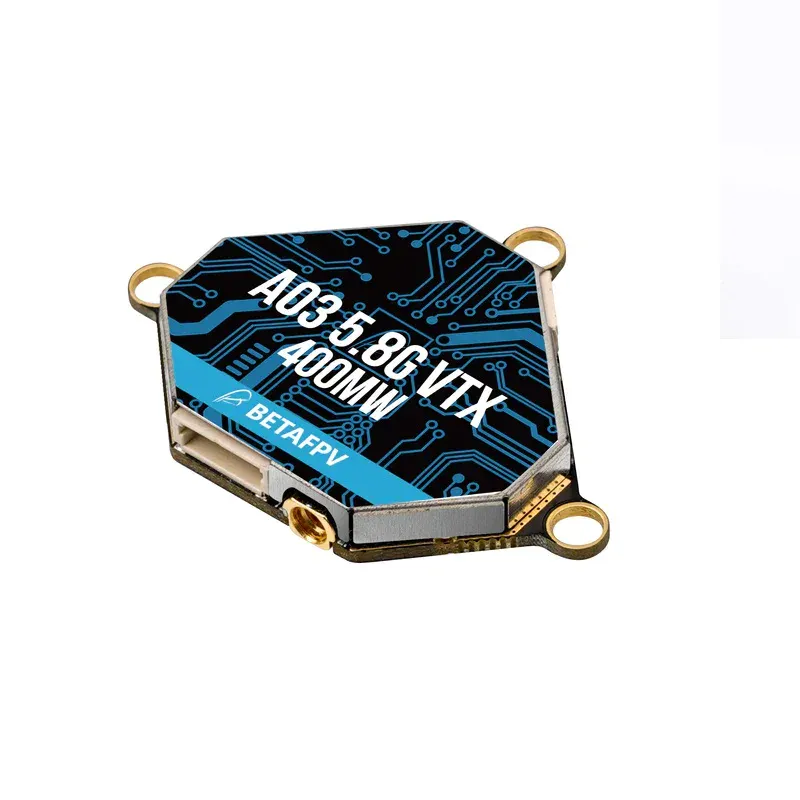
A VTX takes the camera video and broadcasts it on a radio channel to the goggle receiver. On FPV craft the common band is 5.8GHz, though other bands exist for longer range. The visible result depends on three things: how much power the VTX sends, which channel it uses, and how well the receiving antenna listens. The catalog spans the range, from the 9imod 5.8GHz VTX to the A03 400mW 5.8GHz VTX.
Power is capped by law
More VTX wattage buys range, but it also drains the battery and, more importantly, is capped by regulation. Local rules limit 5.8GHz output in most places, and flying over the limit on a shared frequency interferes with everyone else. Size the VTX to a legal power that still covers your flying site, use pit mode on the bench so you do not blind the field, and change channel before increasing power. The Walksnail Avatar HD Pro kit represents the digital HD end of the spectrum, where the encoding itself changes the picture quality.
Analog versus digital HD
Analog video degrades gracefully — the picture gets noisy as you drift out of range but stays connected. Digital HD links deliver a crisp image at distance but may cut out entirely near the edge. Choose analog for reliability and low latency, and digital HD for a sharper immersion. The receiver side matters as much: a 3.3GHz 16-channel video receiver paired with the right antenna pulls the feed in cleanly, and diversity antennas on the goggles handle the drone turning.
Buyer takeaway
Match the VTX power to a legal level that covers your site, pair it with a channel that is free on the field, choose analog or digital by whether you value graceful degradation or sharpness, and invest in the receiving antenna. The supporting radio gear sits in the 9imod accessory range. A well-paired video link feels effortless; an over-powered one just draws current and invites interference.

Power and the law
A VTX is capped by the radio authority. The permitted power differs by country and by band, and flying above the limit interferes with other pilots. The catalog Rush Tank Solo VTX is a high-power analog unit, but the field operator sets it to the legal limit for the location. Run the lowest power that gives a clean feed.
Channels and the pit
VTX channels are grouped by band. A busy field has a frequency plan, and two pilots on the same channel see a merged picture. Set the channel before arming, not mid-flight. The catalog Rush Cherry II antenna pairs with the VTX, and the polarization must match the goggles.
Analog versus digital HD
Analog VTX is simple, cheap and low-latency. Digital HD VTX encodes a cleaner picture but adds latency and a codec. The catalog spans both, and the buyer picks the link by flying style. A freestyle pilot wants the lowest-latency analog; a cinematic pilot wants the cleanest digital. Match the VTX to the link the goggles accept.
Antenna and polarization
The VTX antenna decides whether the power reaches the goggles. A low-gain omni covers close flying; a high-gain patch covers range. Polarization must match between the airframe and the goggles, because a mismatch drops the picture faster than low power. The catalog Rush Cherry II antenna is the airframe half, and the goggle antenna pairs with it.
VTX pit rules
In the pit, keep the VTX off or on the lowest power. A 1.6W VTX on the bench blocks the whole field. Set the channel and the power at the bench, then arm only at the flight line. The catalog Rush Tank Solo VTX is the high-power unit, and the field operator sets it to the legal, low-power setting in the pits.
The buyer checklist
Before ordering a VTX, match the link to the goggles. Analog goggles want an analog VTX; digital goggles want the matching digital VTX. Set the channel and the power at the bench. Match the antenna polarization. Run the lowest power that gives a clean feed. The catalog Rush Tank Solo VTX is the high-power option, and the field operator sets it to the legal limit.
The buyer takes away a simple rule: match the VTX to the goggles, set the channel at the bench, match the antenna polarization, and run the lowest legal power. The catalog VTXs are the link; the field operator sets the channel.
A VTX is a link, and the link is only as clean as the channel and the antenna. Set the channel at the bench, match the polarization, and run the lowest power. The catalog VTXs are the hardware; the channel plan is the field etiquette.
The field bag carries a spare antenna and a small screwdriver. A loose antenna is the most common picture loss. The catalog VTXs are the link; the spare antenna keeps the link alive.