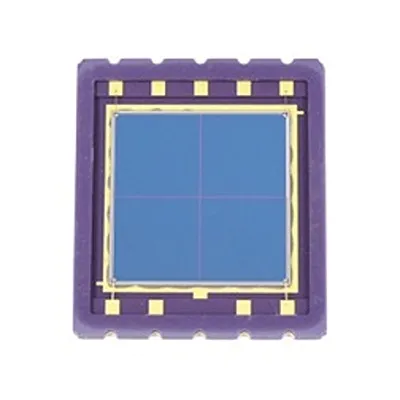
Multi-element photodiode S5981
The Hamamatsu Photonics Si-contact photodiode array is designed for precise illumination sensing. It has a multi-element structure, making it ideal for applications that require precise light source location and measurement.
USD · Volume pricing available
Categories:
Certifications
Global Shipping 7-14 Days
DHL, FedEx, UPS, Air & Sea
Genuine Products
Authorized distribution
Export License Ready
ECCN, CO, CI, PL, EUS docs
24/7 Tech Support
Pre & post sales
Export Compliance
EAR99AI confidence 90% · NLR — No license required. Standard end-use statement recommended.
Buyer Tier Benefits
Tier discounts stack with volume pricing. Automatically applied after your first order.
Buy Hamamatsu S5981 Multi-Element Photodiode for Accurate Light Sensing
Hamamatsu Photonics is a Japanese company founded in 1953. It is a world leader in optoelectronics. The brand produces a wide range of optical sensors. These are Avalanche Photodiodes (APDs) for high precision measurements. The company creates silicon PIN photodiodes for high-speed detection.
The line includes PMTs (photomultiplier tubes) for ultra-low light fluxes. Hamamatsu develops CMOS and CCD sensors for cameras and scientific instruments. The brand's products are used in medicine, telecoms and lidars.
- A matrix of four independent elements for positioning light.
- High sensitivity 0.72 A/W at peak 960 nm.
- Wide spectral range from UV to IR (320–1100 nm).
- High-speed response with a cutoff frequency of 20 MHz.
- Compact surface mount housing (1.26 mm).
How does a four-element photodiode work?
Each of the four segments converts light into current. Signal differences between elements indicate source displacement. This way the sensor accurately determines the coordinates of the light spot.
Technical characteristics and functionality
Model S5981 contains four sensitive segments. The general light-receiving area has a size of 10×10 mm. The spectral range of the device is 320–1100 nm. Typical sensitivity peak wavelength is 960 nm. Photosensitivity reaches 0.72 amperes per watt.
Dark current does not exceed 4000 picoamps. The cutoff frequency is 20 megahertz. The junction capacitance is 35 picofarads. Reverse voltage up to 30 volts. The body is made of ceramic. Operating temperature from -40 to +100 °C.
Sensor Applications
Alignment of optical axes of lasers, level gauges, guidance devices. Scientific instrumentation and industrial automation. Medical detectors and telecommunications. LiDAR and defense technology.
- Photodiode type: segmented
- Cutoff frequency (typ.): 20 MHz
- Measuring conditions: typ. Ta = 25 °C, per element (except photosensitive area), unless otherwise stated. Photosensitivity: λ = 960 nm
- Photosensitivity (typ.): 0.72 A/W
- Peak sensitivity wavelength (typ): 960 nm
- Spectral response range: 320 to 1100 nm
- Cooling: uncooled
- Packing: ceramic
- Number of elements: 4-segment
- Features: multi-element